

Learning Theory
Ready to geek out on the science behind dog training? Then you’re in the right place! I’ve broken down Learning Theory in plain English, so you don’t need a PhD to get it. But hey, if dog training nerdiness isn’t your thing, just skip this section.
N E E D P E R S O N A L I Z E D H E L P ?
OPERANT CONDITIONING
Operant conditioning is all about how behaviors get stronger or fade away. Basically, your dog makes choices and learns from what happens next. The outcomes are explained with four key terms: positive, negative, reinforcement, and punishment. Forget the emotional baggage tied to these words—let’s dive into their straight-up scientific meanings.

TERMS DEFINED
-
In this context, "positive" means you’re adding something into the mix after your dog's action. This "something" doesn’t have to be a physical object—it just needs to be noticeable to your dog. It could be a sound (like praise), something tactile (like petting), or an actual item (like a treat or toy).
-
"Negative" in this context means taking something away or withholding it after your dog's action. That "something" doesn’t have to be a physical object—it just needs to be something your dog notices. It could be withholding a treat, taking away a toy, or even removing your attention.
-
Reinforcement is anything that strengthens a behavior or makes a behavior more likely to happen again in the future.
-
In scientific terms, punishment is anything that reduces a behavior or makes it less likely to happen again. If something you do causes your dog to back off a certain behavior or stop it entirely, you’re technically “punishing” that behavior. But don’t worry—punishment doesn’t have to be harsh. When applied fairly and gently, it can be a useful tool for guiding your dog away from unwanted actions.
NOTE: Writing this section was a bit of a struggle because "punishment" is such a loaded word—and for good reason. Traditional dog training often leaned way too hard on harsh punishment. Thankfully, dog training has evolved, and while there are still some overly tough trainers out there, they’re fewer and farther between. I’m all about a balanced approach that mixes fair boundaries with plenty of genuine affection—it’s the recipe for a well-rounded dog. So, as you read about “punishment,” remember it can be as mild as a firm “no” or not giving a treat if your dog doesn’t respond to a cue.
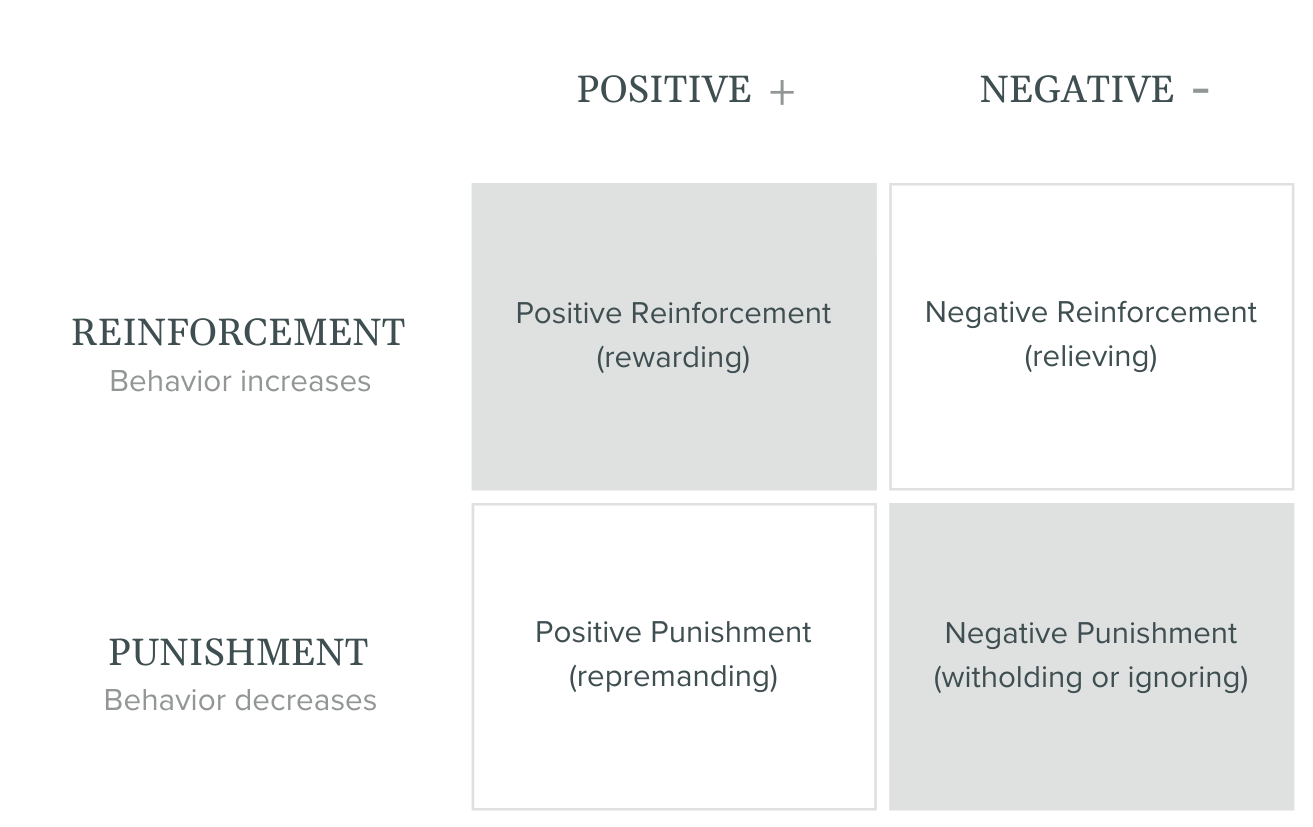
THE FOUR QUADRANTS
-
Positive reinforcement is all about making a behavior stronger by adding something your dog likes. For example, if I ask my dog to sit and they do, I reward them with a treat. In this case, the treat acts as a positive reinforcer, making my dog more likely to sit when I give the cue in the future.
-
The term "negative reinforcement" often gets misused, even by dog trainers, as a stand-in for punishment—but that’s not what it means. Negative reinforcement actually strengthens a behavior by taking away something unpleasant. In plain English, it’s all about “relief.”
I find negative reinforcement especially helpful for tackling fear-based responses in dogs. We’ll dive deeper into this later, but here’s the gist: if my dog is brave enough to approach something they find scary, I let them back off for a bit afterward. This gives them a break from the stress they were feeling. This technique, known as “approach and retreat,” allows the dog to face their fears in manageable doses, giving them relief when they move away. Over time, instead of becoming more anxious around the scary thing, the dog learns to relax.
-
Positive punishment might sound like an oxymoron, but let’s break it down. Here, "positive" means adding something, and "punishment" means reducing a behavior. So, positive punishment is about decreasing a behavior by adding something your dog doesn’t like. For example, saying “no” in a firm tone is a form of positive punishment.
-
Negative punishment involves reducing a behavior by taking away something your dog likes. For example, if your dog tries to get your attention by pawing at your leg and you respond by walking away (withholding your attention), that’s negative punishment. Your dog will likely be less inclined to paw at you for attention in the future.
“Dog training is grounded in real, powerful theories, but remember—your dog is not your mirror. While your actions do influence their behavior, dogs are autonomous beings with feelings and innate drives that have nothing to do with you. And that’s perfectly okay. It doesn’t make you—or them—a failure.”
— Alyssa J. David
-
Beyond understanding what motivates your dog, you’ve got to recognize just how far their natural drives will let you modify their behavior. Operant conditioning can work wonders, but it’s not some magic spell that can totally override deep-seated instincts or trauma. I’m bringing this up because there are a ton of books out there that make it sound like if you just stick to the basics of operant conditioning, your dog will always do exactly what you’ve reinforced. Spoiler alert: that’s not true, and pretending otherwise isn’t fair to you or your dog. Can you make progress with patience and consistency? Absolutely! But there are some issues you’ll never be able to completely fix. Sometimes, you’ve got to make a compromise instead of pushing for total behavior change.
CLASSICAL CONDITIONING
Classical Conditioning is all about triggering automatic, involuntary behaviors on cue. In simple terms, it’s like teaching someone to have a reflex to something that wouldn’t normally cause that reaction. This technique, made famous by Pavlov, isn’t used as often in dog training since it deals with reflexes rather than conscious responses, but it’s still pretty interesting. Here’s how it works:
Imagine you want to make salivation—an involuntary response—happen on command using classical conditioning. First, you need an unconditioned stimulus, which is something that naturally triggers an automatic reaction, known as the unconditioned response. In this case, the unconditioned stimulus is sucking on a lemon, which naturally makes you salivate (the unconditioned response).
To create a new trigger, you introduce a conditioned stimulus, which is something that doesn’t naturally cause the response you’re after. Let’s say the conditioned stimulus is the word “salivate.” You’d say “salivate” and then immediately have the person suck on the lemon. Over time, just hearing the word “salivate” will make their mouth water, even without the lemon. Congratulations—you’ve successfully conditioned them to salivate on cue! The natural, unconditioned response has now become a conditioned response, thanks to the new association.
FREE TRAINING GUIDES


Need personalized help?
Sometimes written advice isn’t enough. For real results and customized training tips for your pup, give me a shout. I’d love to team up and tackle those training challenges together!